

AUTIVERSE STORIES
Reflections grounded in neuroaffirming practice and lived experience.
A space for shared stories, reflections, and learning. This page brings together voices from neurodivergent individuals, families, and neuroaffirming practitioners through posts and videos, creating opportunities for understanding, connection, and respectful dialogue.

This is a video series exploring neurodiversity through lived experience, parent voices, and neuroaffirming practice. It invites unlearning, reflection, and deeper understanding of autism and neurodiversity beyond labels, deficits, and stereotypes.
Series Episodes
Part I: Unmasking Autism – Redefining Perspectives
Exploring autism beyond surface-level narratives, with a focus on identity, masking, and reframing dominant perspectives.
Part II: Love Unbounded – Challenges and Hopes of Parents of Autistic Children
Honest reflections from parents navigating uncertainty, resilience, advocacy, and unconditional love.
Part III: Neurodiversity – The Spectrum of Human Brilliance
A conversation on neurodiversity as a natural and valuable part of human variation, moving beyond deficit-based frameworks.
Part IV: Paving the Path to Inclusion
Messages from autistic individuals, parents, and neurodiversity-affirming professionals on building more inclusive, respectful, and accessible worlds.
(Parts I–III are available on YouTube, while later parts are shared on Instagram)

Inspired by The Whole-Brain Child by Dr. Dan Siegel and Dr. Tina Bryson
This short video series shares key ideas from The Whole-Brain Child, a book that offers a compassionate and accessible understanding of how children’s brains develop and how behaviour is shaped by brain integration.
Series Episodes
Part I: Understanding the left and right brain hemispheres
Part II: Horizontal integration – supporting emotions and logic to work together.
Part III: Vertical integration – supporting regulation through connection, co-regulation, and safety before problem-solving

(Content note: This video includes representations of sensory overload.)
This short video offers a glimpse into how the world can sometimes be experienced from an autistic perspective. It reflects moments of sensory overwhelm, alongside the strengths and unique ways autistic individuals experience everyday life. Created during Autism Acceptance Month, the video invites viewers to pause, listen, and deepen their understanding—shifting away from ideas of “fixing” autistic individuals and toward acceptance and genuine inclusion.


Every child has their own unique rhythm and pace for learning. Dr. Bindiya Shajith, a school psychologist, child-rights advocate and the founder director of Allinclusive foundation, highlights the beauty of truly listening to a child—understanding their readiness, respecting their needs, and honoring their individuality. She reminds us of the importance of meeting children where they are and nurturing their growth in a way that feels safe, supportive, and joyful.
***This content is an excerpt from the podcast- 'Bindiya Shajith's fight for inclusivity', with full credit to its creators, Newsreel Asia***
What does it really mean to be neurodiversity-affirming?
It’s a term we hear often—but it’s not a checklist, a technique, or a label we apply once and move on from.
For me, being neurodiversity-affirming is a core value. It’s a lifelong process of unlearning ableist ideas, questioning what we’ve been taught to see as “normal,” and choosing inclusion, access, and respect every day.
Understanding Adverse Childhood Experiences (ACEs)
This post highlights how Adverse Childhood Experiences (ACEs) can shape a child’s stress responses, attachment, and long-term physical and mental health. By looking beyond observable behaviours and understanding the underlying impact of trauma, professionals and caregivers can offer more compassionate, effective support. This reflection is inspired by the work of Dr. Nadine Burke Harris, whose contributions have deepened our understanding of childhood trauma and resilience.

When a child struggles, we often ask, “Are they doing this on purpose?” But what if the more important question is, “What are you trying to tell me?” This post invites us to look beyond behaviour and consider how sensory experiences, overwhelm, and unmet needs shape a child’s responses—and how understanding can change the way we support them.

Autistic brains process the world differently. What may look like “fixation” or “obsession” is often a response to unpredictability, sensory overload, or anxiety. Holding on to a familiar object can bring comfort, regulation, and a sense of safety. These objects act as anchors—helping autistic children feel grounded in a world that can often feel overwhelming and uncertain. When we understand the why behind the behaviour, we move from trying to take things away to offering safety, trust, and support.

Neurodivergence doesn’t end in childhood—it continues into adulthood, often unnoticed or misunderstood. Through my clinical work, I have seen how many neurodivergent adults navigate years of masking, exhaustion, and unmet needs. This post shares reflections from my practice and is an invitation to listen more closely and approach neurodivergent adults with understanding and respect.

Too often, group therapy is designed to correct neurodivergent children by enforcing neurotypical norms. But this approach dismisses their experiences and often leads to masking, stress, and emotional invalidation.
A neuroaffirming approach is different:
• It validates neurodivergent ways of interacting
• Helps children understand emotions through interoception, not forced expressions
•Encourages self-advocacy for sensory and energy needs
•Teaches neurotypical rules as tools — not requirements
The goal isn’t conformity.
The goal is authentic connection, self-understanding, and mutual respect.


Connection isn’t just about eye contact or pointing—it happens in many ways!
Traditional ideas of joint attention often miss the full diversity of human interaction. Autistic individuals may engage in joint attention through movement, sharing an object, or even simply knowing that someone else is experiencing the same moment. These ways of connecting are just as meaningful and valid.
Swipe through to explore a more inclusive, neuroaffirming perspective!
(Reference article: Gernsbacher, M. A., Stevenson, J. L., Khandakar, S., & Goldsmith, H. H. (2008). Why Does Joint Attention Look Atypical in Autism?. Child development perspectives, 2(1), 38–45)
Often, fluent speech is seen as "ideal," making stuttering seem like a deviation from the “right” way to speak. But what if we viewed stuttering differently? What if, instead of seeing it as something to fix, we embraced it as a natural variation in communication—a part of verbal diversity? From a neurodiversity perspective, stuttering isn’t a flaw; it’s just one of the many ways people speak. When we shift our focus away from fluency and start listening to the experiences of those who stutter, we realize it’s not about forcing change but about creating an environment where every voice feels valued and understood. Stuttering is not wrong—it’s simply different, and that difference should be honored.
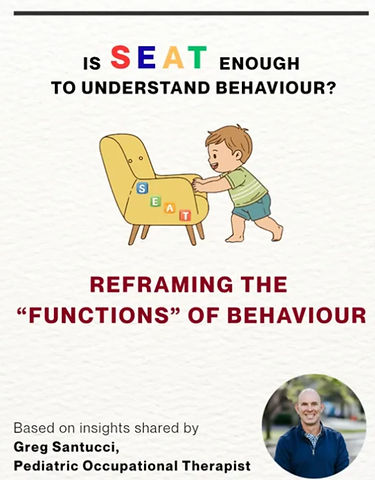
When professionals begin working with children, one of the first words they often encounter is “behaviour.” Attention-seeking behaviour.
Tantrums. Avoidance.
These labels are often used in ways that suggest the child’s behaviour is something that needs to be managed, corrected, or fixed. But a child’s behaviour is rarely that simple. Behaviour is shaped by a child’s experiences, emotions, skills, relationships, and environment. Yet something as nuanced as a child’s behaviour — and the purpose it serves — is often reduced to four functions: sensory, escape, attention, and tangible (SEAT). Here's a thoughtful reframe shared by Greg Santucci, a pediatric occupational therapist and the founding director of Power Play Pediatric Therapy.
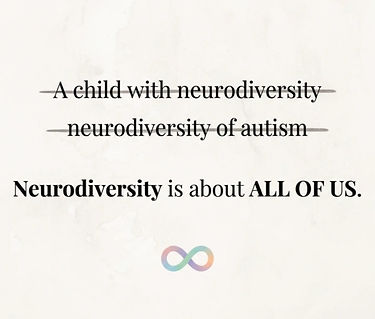
NEURODIVERSITY—a term that has become a buzzword. A term that was hardly known a decade ago, but now generates about 41,300 results on Google Scholar. But have we really understood what it means?